
Linux Boot Process
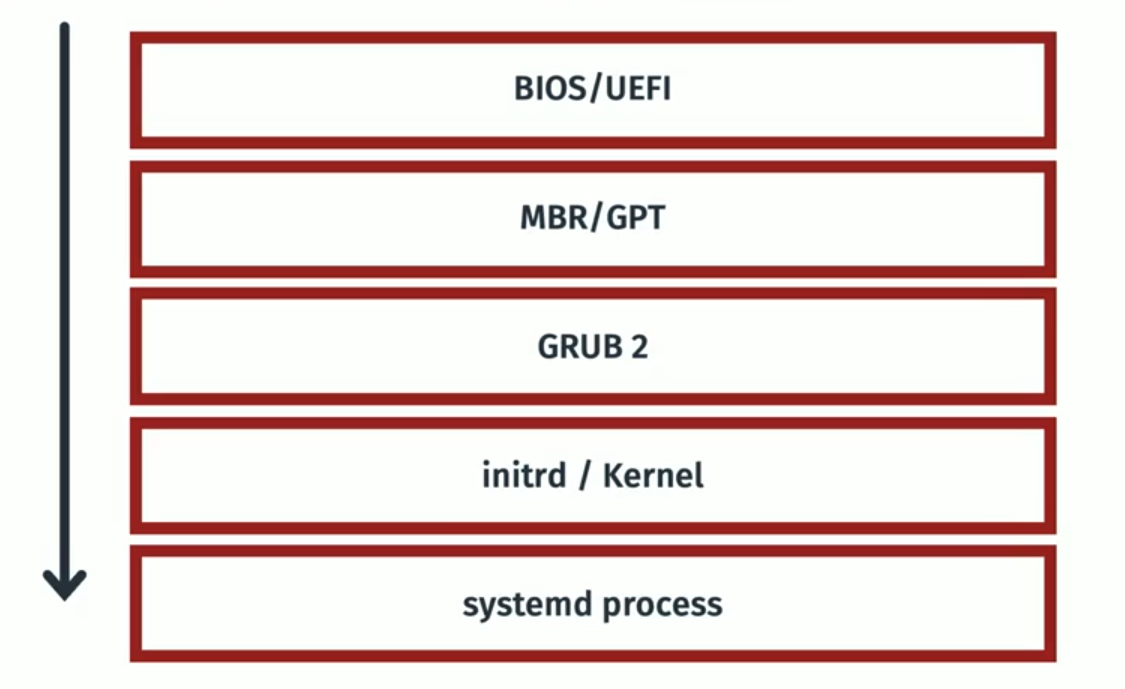
The below image outlines the typical flow of a Linux system boot.
------------------------------------------------------------------------------------------------------------------------------------------------====================================================================================
BIOS (Basic Input/Output System) & UEFI (Unified Extensible Firmware Interface)
BIOS (Basic Input/Output System) and UEFI (Unified Extensible Firmware Interface) are both firmware interfaces that provide a critical layer between your hardware and operating system during the startup process. However, they differ significantly in their functionality and capabilities.
Similarities:
- Both BIOS and UEFI are pre-installed on your motherboard and activate when you turn on your computer.
- They perform essential tasks like initializing hardware components, performing power-on self-tests (POST), and loading the operating system from a storage device.
------------------------------------------------------------------------------------------------------------------------------------------------====================================================================================
MBR - master boot record & GPT - GUID partition table
MBR (Master Boot Record) and GPT (GUID Partition Table) are both partition table formats used on hard disk drives (HDDs) and solid-state drives (SSDs) to define how the storage space is organized. However, they have some key differences:
Similarities:
- Both MBR and GPT are located at the beginning of a storage device and define how the storage space is divided into partitions.
- They both store information about each partition, such as its size, file system type, and location on the disk.
- Both allow you to create multiple partitions on a single storage device, enabling you to manage different operating systems or data types more efficiently.
- Identification of boot loader (typically at beginning of disk) - Once identified, the boot process is handled by the boot loader - most commonly GRUB2.
Note; MBR is an older standard of partitioning, most systems will now use GUID.
------------------------------------------------------------------------------------------------------------------------------------------------====================================================================================
GRUB2 (Grand Unified Boot Loader)
GRUB2 is a software program, specifically a bootloader. Its primary function is to take control during the computer startup process after the firmware (BIOS or UEFI) has initialized the hardware. Here's a breakdown of its role:
- Loading the Operating System Kernel: GRUB2 locates the kernel (the core program) of your operating system on the storage device. It then loads this kernel into memory.
- starts kernel and systemd.
====================================================================================
Initrd & Kernel
------------------------------------------------------------------------------------------------------------------------------------------------
InitrdWhat &is Kernelinitrd?
initrd
(initialisationWhichRAM filedisk) is essentially a set of instructions used to load the kernel. initrd is stored temporarily in /bootsystem ismemory the kernel?
Typically,whilst the kernel file itself (located within /boot) is prefaced with 'vmlinuz', for example:
vmlinuz-5.15.0-106-generic
loaded.
------------------------------------------------------------------------------------------------------------------------------------------------
What is a Linux Kernel?
------------------------------------------------------------------------------------------------------------------------------------------------
Which file in /boot is the kernel?
Typically, the kernel file itself (located within /boot) is prefaced with 'vmlinuz', for example:
vmlinuz-5.15.0-106-generic
Working on Linux systems, you may see systems with various kernels installed.
Which file in /boot is initrd?
The initrd file will be prefaced with just that - initrd:
initrd.img-5.15.0-106-generic
------------------------------------------------------------------------------------------------------------------------------------------------
To check which kernel is currently being treated as the primary one (which will be loaded on boot), you can check the symlinks (in /boot), as below:
vmlinuz -> vmlinuz-5.15.0-107-generic
vmlinuz.old -> vmlinuz-5.15.0-106-generic
The same applies to the initrd files:
initrd.img -> initrd.img-5.15.0-107-generic
initrd.img.old -> initrd.img-5.15.0-106-generic
------------------------------------------------------------------------------------------------------------------------------------------------
====================================================================================
Systemd
Systemd is the first process that starts on a booting OS.
------------------------------------------------------------------------------------------------------------------------------------------------